





Do you want your Intune purchase to be “right-sized,” not “expensive”?
At MSAdvance, we help you make decisions with clear criteria: use cases, risk, operational ROI, and licensing model. The goal is simple: buy what you need to reduce support friction, improve security, and standardize endpoints.
- Licensing assessment: Plan 1 vs Plan 2 vs Suite, and which add-ons you do/don’t need.
- 30/60/90 roadmap: adoption, hardening, support, and KPI measurement.
- Design by workforce segment: office, frontline, BYOD, kiosks, rugged, multi-OS.
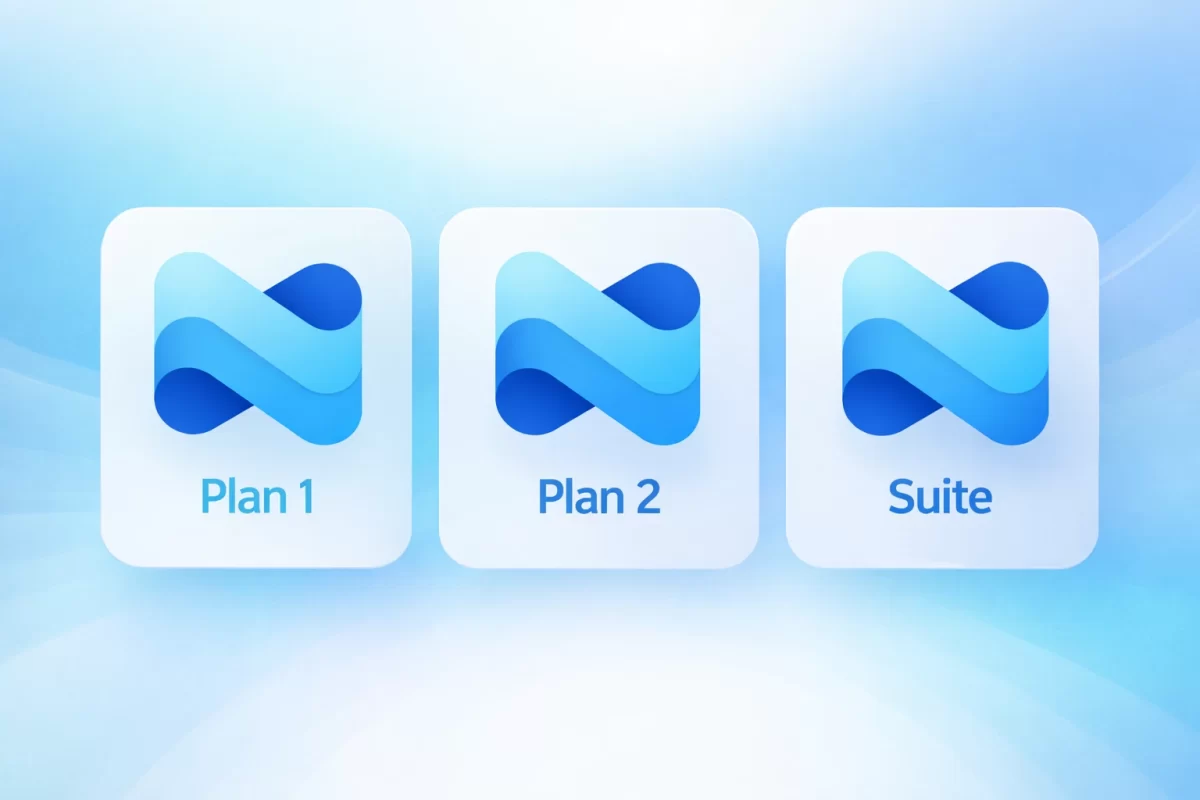
Plan 1 is your UEM foundation (MDM/MAM) and a prerequisite for everything else. Plan 2 adds specific capabilities (such as Microsoft Tunnel for MAM, specialized device management, and FOTA firmware updates). Intune Suite includes Plan 2 capabilities plus premium modules such as Remote Help, Endpoint Privilege Management, Advanced Analytics, Enterprise App Management, and Cloud PKI. The right purchase depends on how many of those modules you will truly use (and for which workforce segments). (See: official Intune licensing)
Executive summary: 12 decisions that determine whether you buy right
In practice, Intune purchasing mistakes are usually not “technical”: they are about prioritization. If you decide these 12 points early, licensing becomes cleaner and deployment stops being reactive.
- What problem do you want to solve first? (support, security, BYOD, apps, certificates, analytics).
- Who are your workforce segments? office, frontline, BYOD, kiosk, rugged, VIP, third parties.
- Which OS do you manage today and tomorrow? Windows, macOS, iOS/iPadOS, Android (and what level of control you need).
- Is your #1 pain point support? (resolution time, repetitive tickets, remote assistance).
- Is your #1 pain point “local admin”? (security, audit, ransomware, least privilege).
- Do you need private per-app access in BYOD? (without full device enrollment).
- Do you have specialized devices? (rugged/scanners, HoloLens/AR, kiosks, single-purpose devices).
- Do you have app chaos? (Win32, packaging dependency, updates, visibility).
- Are certificates a bottleneck? (PKI, renewals, Wi-Fi/VPN, SCEP/NDES, complexity).
- Do you need real analytics for operations? (proactivity, digital experience, prioritization).
- What percentage of users needs “premium”? (it is not always 100%).
- How will you measure success? support, security, compliance, and productivity KPIs (not just “devices enrolled”).
Quick comparison: Plan 1 vs Plan 2 vs Intune Suite
| Block | Intune Plan 1 | Intune Plan 2 | Intune Suite |
|---|---|---|---|
| What it is | UEM base (MDM/MAM) and standard security | Add-on on top of Plan 1 (specific capabilities) | Add-on on top of Plan 1 (premium bundle + includes Plan 2 capabilities) |
| Includes Plan 2 capabilities | Not applicable | Yes (native to Plan 2) | Yes (Suite includes Plan 2 capabilities) |
| Remote support | Basic (depending on external tools) | — | Remote Help (Suite module) |
| Least privilege | Standard controls | — | Endpoint Privilege Management (Suite module) |
| Advanced analytics | Base | — | Advanced Analytics (Suite module) |
| Enterprise apps | Standard app management | — | Enterprise App Management (Suite module) |
| Certificates | Standard integrations (depending on scenario) | — | Cloud PKI (Suite module) |
| BYOD with private per-app access | Basic MAM | Microsoft Tunnel for MAM | Microsoft Tunnel for MAM (via Plan 2 capabilities) |
| Specialized devices | Base | Specialized device management | Specialized device management (via Plan 2 capabilities) |
| Firmware (FOTA) | Base | Firmware over-the-air | Firmware over-the-air (via Plan 2 capabilities) |
Official references: Available licenses for Microsoft Intune · Microsoft Intune pricing (includes Suite)
1. Concepts that prevent bad buying decisions (base plan vs add-ons)
The most stable way to understand Intune in 2026 is this: Intune Plan 1 is the foundation (and prerequisite) for endpoint management. Plan 2 and Intune Suite are add-ons layered on top of Plan 1 to unlock advanced capabilities. (See: official licensing)
1.1 What Microsoft makes clear (and worth remembering)
- Plan 2 is an add-on layered on top of Plan 1 (reference).
- Intune Suite is an add-on layered on top of Plan 1 and includes multiple solutions (reference).
- Intune Suite includes (among others) solutions such as Remote Help, Endpoint Privilege Management, Advanced Analytics, Enterprise App Management, and Cloud PKI.
- Plan 2 includes capabilities such as Microsoft Tunnel for MAM, specialized device management, and firmware over-the-air.
1.2 The typical mistake: buying by “name” instead of by “use case”
In procurement, it is common to hear: “Is Plan 2 better than Plan 1?”. The right question is: which use cases can’t I solve well with Plan 1?
Because Plan 1 covers the UEM baseline; Plan 2 and Suite add specific capabilities. If you do not have that use case (or won’t deploy it), you will pay for dormant capabilities.
2. Intune Plan 1: what it includes and when it is enough
Intune Plan 1 is the “engine” of modern endpoint management: enrollment, policies, compliance, app distribution, and baseline controls for Windows, macOS, iOS/iPadOS, and Android (according to your design). It is also the prerequisite on which Plan 2 and Suite are built. (See: official licensing)
2.1 When Plan 1 is usually enough
- You are standardizing modern management and moving away from legacy GPO/tools or fragmented tooling.
- Your main objective is compliance + policies + standard apps.
- Your support model is reasonable with current tools and you do not yet need a premium layer.
- You do not have (or have not yet prioritized) BYOD with private per-app access, specialized devices, or managed firmware.
2.2 Problems Plan 1 solves well (if deployed with method)
Typical use cases
- Predictable onboarding: device provisioning + policies + day-1 apps.
- Security baseline: coherent minimums by platform and workforce segment.
- Reduced drift: more consistent devices and fewer repetitive tickets.
- App control: standard rollout, removal, and minimum versions.
2.3 “What Plan 1 is not” (to avoid wrong expectations)
- It is not automatically “premium remote assistance” (that is Remote Help inside Suite).
- It is not “least-privilege managed with request/approval workflows” (that is Endpoint Privilege Management in Suite).
- It is not “advanced observability and proactive recommendations” (that is Advanced Analytics in Suite).
3. Intune Plan 2: what it really adds (and for whom)
Intune Plan 2 is an add-on for Plan 1. (See: official licensing) In 2026, its value is concentrated in very specific capabilities that not all organizations need: Microsoft Tunnel for MAM, specialized device management, and firmware over-the-air (FOTA).
3.1 Microsoft Tunnel for MAM: BYOD with private “per-app” access
If your strategy includes BYOD or personal devices, you often do not want (or cannot) fully enroll the device with MDM, but you still need a corporate app to access internal resources (for example, an API, internal portal, or legacy app).
This is where Microsoft Tunnel for Mobile Application Management (MAM) fits: private access for protected apps, without necessarily requiring full-device control. (Doc: Microsoft Tunnel for MAM)
3.2 Specialized device management: when “they are not normal PCs”
If you manage rugged devices, scanners, shared devices, AR/VR, or devices with special needs (for example, frontline hardware-specific endpoints), the “standard” model can fall short in integration, profiles, or lifecycle control.
Plan 2 includes specialized device management as an additional capability. (Doc: Specialized devices (overview))
3.3 Firmware over-the-air (FOTA): firmware control as part of operations
In retail, logistics, and industry, firmware can be a real incident source. The ability to update firmware in an orchestrated way reduces tickets and improves stability. Plan 2 includes firmware over-the-air updates as part of its capabilities. (Doc: Firmware over-the-air (overview))
4. Intune Suite: what it includes, what it solves, and when it is worth it
Microsoft Intune Suite is an add-on on top of Plan 1. (See: official licensing · official pricing) Its value is that it bundles several premium solutions and also includes Plan 2 capabilities. In practice, Suite pays off when you will deploy two or more of these modules with real adoption (not “just in case”): Remote Help, Endpoint Privilege Management, Advanced Analytics, Enterprise App Management, Cloud PKI.
4.1 Remote Help: lower MTTR and support “human cost”
Remote Help is designed so IT support teams can assist users through integrated, governed remote control. If you currently rely on external tools, unclear permissions, or poor traceability, Remote Help is often highly cost-effective once incident volume justifies standardization.
When to buy it
- If your helpdesk wastes time on “can you see my screen?” and tool switching.
- If you need auditing and control over remote sessions.
- If you support remote/frontline groups where “ad-hoc support” is expensive.
How to measure ROI (in business language)
- MTTR (mean time to resolution) and first-contact resolution.
- Reduced escalations and repetitive tickets through guided assistance.
4.2 Endpoint Privilege Management (EPM): “no local admin” with controlled exceptions
EPM lets you implement a least-privilege model on Windows endpoints, reducing dependence on local admin rights. This is often one of the biggest improvements in security posture (and in incident reduction from privileged execution). EPM is part of Intune Suite.
When to buy it
- If your security strategy is blocked by “users cannot work without local admin.”
- If audits require evidence of least-privilege controls.
- If malware/ransomware is a real concern and you want to reduce attack surface.
Pattern that works
First remove local admin from standard user groups, then define controlled elevation for specific apps/processes, and finally address “hard” groups (IT, engineering, lab) with finer-grained rules.
4.3 Advanced Analytics: move from reactive to proactive
Advanced Analytics adds advanced analysis capabilities to prioritize actions, understand digital experience, and make data-driven decisions (not intuition-driven). It is part of Intune Suite.
When to buy it
- If your team spends all day firefighting and you need impact-based prioritization.
- If you need visibility to justify investments (hardware refresh, version changes, standardization).
- If you want early degradation detection and fewer tickets before they happen.
4.4 Enterprise App Management (EAM): less friction with “difficult” apps
Enterprise App Management is aimed at simplifying management of certain enterprise apps (especially on Windows), reducing packaging/update effort and improving consistency. It is included in Intune Suite.
When to buy it
- If your bottleneck is “apps”: packaging, updates, dependencies, conflicts.
- If you run many Win32 apps and version maintenance operational cost is slowing you down.
- If your service desk suffers from inconsistent installations/updates.
4.5 Cloud PKI: certificates without operational pain
Cloud PKI is an Intune Suite solution focused on modernizing and simplifying certificate management. If your operation depends on certificates (Wi-Fi, VPN, authentication, secure access) and current infrastructure is fragile, Cloud PKI can be both an operational and security “unlocker.”
When to buy it
- If certificate renewal is a failure point or constant manual workload.
- If you want less dependency on complex infrastructure (or hard integrations) for issuance/management.
- If your Zero Trust strategy requires well-governed certificates.
5. What to buy and when: decision guide by scenario
Here is the part that helps procurement/IT the most: real-pattern decisions. They are not absolute rules, but they are heuristics that usually work.
5.1 Scenario A: SMB/midmarket with a “standardize and comply” objective
- Typical purchase: Plan 1 (well deployed) plus targeted reinforcements as needed.
- When to move up: if support load spikes, consider Remote Help (Suite or add-on, depending on purchasing model).
- Signal: “we have many tickets for installs, blocks, configurations” → ROI is MTTR.
5.2 Scenario B: company with high privilege risk (or strong audit pressure)
- Typical purchase: Plan 1 + EPM (Suite or add-on).
- Why: removing local admin reduces attack surface and improves compliance.
- Signal: “if we remove local admin, work stops” → you need controlled elevation.
5.3 Scenario C: real BYOD (without full MDM) + private access requirement
- Typical purchase: Plan 1 + Plan 2 (for Tunnel for MAM).
- When to choose Suite: if you also want Remote Help, EPM, or Analytics with real adoption.
5.4 Scenario D: frontline/logistics/retail with specialized devices + firmware
- Typical purchase: Plan 1 + Plan 2 (specialized + FOTA).
- When to choose Suite: if remote support and stability analytics are critical at scale.
5.5 Scenario E: mid/enterprise with major app and operations pain
- Typical purchase: Plan 1 + Suite if you will use EAM + Advanced Analytics + (Remote Help or EPM).
- Signal: “apps are consuming us” (packaging, updates, inconsistency) and “we cannot prioritize well” (no data).
6. Smart purchase model: who needs what (not always 100%)
Mature purchasing does not license “everyone the same.” It licenses by segment and by impact. This allows you to:
- Buy Suite for segments with high operational cost (support, risk, complex apps).
- Buy Plan 2 for BYOD or specialized segments.
- Keep Plan 1 as the baseline for everyone else.
6.1 Recommended pattern by segment
| Segment | Typical recommendation | Reason |
|---|---|---|
| Standard office users | Plan 1 | Sufficient UEM baseline and compliance |
| Helpdesk / Support | Suite (for Remote Help) | Direct impact on MTTR and support productivity |
| High-risk profiles (finance, admins, VIP) | Suite (for EPM + controls) | Reduce privilege and exposure |
| BYOD with corporate apps | Plan 2 (Tunnel for MAM) or Suite | Private per-app access without full MDM |
| Frontline / Rugged / Specialized | Plan 2 or Suite | Specialized + firmware (FOTA) and stable operations |
| Teams with many “difficult” apps | Suite (EAM + Analytics) | Reduce app cost and prioritize with data |
7. 30/60/90 roadmap to deploy without “fires”
Buying is the easy part. Value arrives when deployment is structured: first a stable base, then premium modules aligned to a KPI.
7.1 Day 0–30: solid foundation (Plan 1 done right)
- Segments and enrollment: who joins, how, and under which policies.
- Compliance + security baseline.
- Minimum viable app catalog and standards by segment.
7.2 Day 30–60: module “1” with immediate impact
- If support is the pain point: Remote Help (Suite) with runbooks and training.
- If local admin is the pain point: EPM (Suite) with “wave 1” of standard users.
- If BYOD is the pain point: Plan 2 (Tunnel for MAM) with key apps and internal resources.
7.3 Day 60–90: module “2” + measurement + adjustments
- Advanced Analytics to prioritize and automate actions.
- EAM if apps/updates are the bottleneck.
- Cloud PKI if certificates block Wi-Fi/VPN/security or create recurring incidents.
8. KPIs that matter (support, security, and operations)
| Dimension | KPI | Why it matters |
|---|---|---|
| Support | MTTR / First Contact Resolution | Remote Help often justifies investment if it reduces time and escalations |
| Security | % users without local admin | EPM reduces attack surface and improves audit posture |
| Stability | Repetitive incidents per endpoint | Advanced Analytics helps move from reactive to proactive |
| Apps | Installation/update failure rate | EAM reduces friction and manual app operations |
| BYOD | Private per-app access without tickets | Tunnel for MAM avoids parallel solutions and reduces friction |
| Frontline | Firmware incidents / downtime | FOTA and specialized management protect operations |
9. Typical risks and mitigations
| Risk | How it appears | Practical mitigation |
|---|---|---|
| Buying Suite “without a case” | Low usage and unclear value | Buy by segment + KPI by module |
| Weak foundation | Irregular enrollment, inconsistent policies | Plan 1 first (hygiene), then premium |
| Poor EPM adoption | Mass exceptions, bypass behavior | Waves + controlled elevation + app/process owners |
| Remote Help without runbooks | Support works ad hoc | Guides + training + clear permissions and auditing |
| BYOD without architecture | Inconsistent private access | MAM design + Tunnel for MAM with prioritized apps |
10. Purchase and deployment checklists
10.1 Purchase checklist (Procurement + IT + Security)
- Segments defined (who needs what and why).
- Top 3 prioritized use cases and KPI per use case.
- Decision: individual add-on vs Suite (based on number of modules and real scope).
- Plan 2 only if you have BYOD with private per-app access, specialized devices, or firmware requirements.
- 30/60/90 adoption plan and support plan.
10.2 Technical checklist (before “turning on” modules)
- Enrollment and compliance stable in Plan 1.
- Coherent groups and assignments (no “everything to everyone”).
- Runbooks for support (Remote Help), elevation (EPM), and apps (EAM).
- Monitoring and reporting in place (to demonstrate value).
11. Extended FAQ
Does Plan 2 replace Plan 1?
No. Plan 2 is an add-on layered on top of Plan 1. Plan 1 is the base. (See: official licensing)
Does Intune Suite include Plan 2?
It includes Plan 2 capabilities plus modules such as Remote Help, EPM, Advanced Analytics, EAM, and Cloud PKI. (See: official licensing)
What does Plan 2 clearly include to justify it?
Capabilities such as Microsoft Tunnel for MAM, specialized device management, and firmware over-the-air. If you do not have those use cases, Plan 2 may be unnecessary. (Docs: Tunnel for MAM · Specialized devices · Firmware OTA)
When is Suite better than buying separate add-ons?
Usually when you will deploy two or more premium modules (for example, Remote Help + EPM, or Analytics + EAM) with real, large-scale adoption. Suite bundles those capabilities and also includes Plan 2 capabilities. (See: official pricing)
Can I license Suite only for some users?
In many environments, that is the smartest approach: Suite for segments with high operational cost/risk (support, VIP, critical profiles, teams with complex apps), and Plan 1 for everyone else. Always validate details with your purchasing channel (EA/CSP) and each module’s requirements.
Which two modules usually deliver ROI fastest?
Often: Remote Help (through MTTR reduction) and EPM (through reduced local admin risk). It depends on your ticket volume and privilege posture. (Docs: Remote Help · EPM)
12. Official resources and external links
Licensing and comparisons (official)
Intune Suite modules (documentation)
- Remote Help
- Endpoint Privilege Management (EPM) overview
- Advanced Analytics
- Enterprise App Management
- Cloud PKI
Typical Plan 2 capabilities (documentation)
Recommended links (MSAdvance)
Modern Workplace, Microsoft 365 Migration, and all MSAdvance services.
13. Conclusion and next steps
In 2026, the right purchase is usually: Plan 1 as the baseline, Plan 2 if you have BYOD with private per-app access or specialized devices/firmware, and Intune Suite when you will deploy premium modules that lower operational cost and strengthen security posture (Remote Help, EPM, Advanced Analytics, EAM, Cloud PKI). (See: official licensing)
- Define segments and use cases (Top 3).
- Choose add-ons by KPI and real adoption (not by catalog).
- Deploy with a 30/60/90 roadmap and measure outcomes.
Do you want to turn this guide into a finalized (and defensible) decision for your company?
We help you move from “what should I buy?” to “I have a segment-based plan with KPI, cost, and deployment roadmap.”